









This website uses cookies so that we can provide you with the best user experience possible. Cookie information is stored in your browser and performs functions such as recognising you when you return to our website and helping our team to understand which sections of the website you find most interesting and useful.
Disability discrimination claims have risen by 30%, reports HR Magazine, and part of that may be attributed to ongoing conversations surrounding mental health in the workplace. This figure comes from the UK, but the US is similarly affected, with the Equal Employment Opportunity Commission also reporting a rise in claims related to mental health discrimination.
According to a report from the US Surgeon General’s office, up to 75% of US workers report one or more symptoms of mental illness amid a backdrop of rising diagnoses following COVID-19. In a similar vein, the APA reports a 10% rise in diagnosed mental illnesses. This is even more troubling given how many people are likely to be experiencing difficulties but reluctant to reach out given the stigma associated with mental heath issues.
This mental health stigma extends to the workplace – with one-third of people experiencing symptoms of mental illness reporting that they feared being discriminated against as a result of seeking psychiatric help. Trends seem to indicate that they may be correct in this assumption. With cases in which mental health discrimination is cited on the rise, the US Equal Employment Opportunity Commission (EEOC) has announced a crackdown on this form of disability-related discrimination.
What is mental health discrimination at work?
Mental health discrimination at work occurs when an employee or job applicant is treated unfairly because of a current, previous or perceived mental health condition. It can affect recruitment, pay, training, promotion, working arrangements, performance management and dismissal, as well as everyday interactions with managers and colleagues.
Discrimination can be direct, such as rejecting a qualified candidate because they have depression, or indirect, where a workplace policy disadvantages people with particular mental health needs. It can also include harassment, victimisation or failing to provide reasonable adjustments. In the UK, qualifying mental health conditions are protected under the Equality Act 2010, while the US Americans with Disabilities Act provides similar protections for eligible employees and applicants.
Fortunately, both the Americans With Disabilities Act (ADA) and the UK’s Equality Act offer protection to people with psychological conditions that impact life activities. That said, the onus is on employees to create a safe, supportive and equitable environment not only for existing employees but also for job applicants who have issues with their mental health.
Apart from examining the laws protecting people with mental health concerns, this article looks at how employers can counter prejudice and stereotypes, as well as the benefits of taking a proactive approach to mental health discrimination at work.
Examples of mental health discrimination in employment and in the workplace
Like all types of discrimination, mental health discrimination can be both obvious and overt (commonly referred to as ‘direct’ discrimination) or subtle and ‘indirect’.
Direct mental health discrimination
When direct discrimination occurs, it is relatively easy to spot. Simply put, the employee or candidate is directly disadvantaged due to their mental illness. For instance, they may be passed over for certain opportunities due to being perceived as less competent or capable than their peers. At the worst end of the scale, some employees may be isolated, mocked or victimized by their colleagues due to having mental health challenges.
Similarly, HR may decide to refrain from promoting an employee who has experienced a mental health issue. The decision to overlook the employee is not based on their performance, but on the knowledge that a mental health challenge exists. This would represent direct discrimination.
Another example of direct mental health discrimination is during the hiring process. For instance, if a candidate were to disclose a history of mental health issues during an interview, it would be direct discrimination for a recruiter to decide against hiring them based on the assumption that they may not be able to perform in the role – despite having all the required skills and attributes.
Direct discrimination can result in job losses, too. For example, an employee experiencing severe depression is laid off or fired after taking leave under the FMLA to undergo treatment or medically recommended recovery. In this instance, the employer fails to recognize reasonable accommodations for a protected disability.
Indirect mental health discrimination
Indirect discrimination is harder to spot because it mainly comprises actions and policies that, while not intended to harm or disadvantage people with mental health conditions, negatively impact them or fail to recognise their needs and requirements.
In particular, rigid work schedules can disproportionately affect people with disabilities of any description. Reasonable accommodation remains the principal for employers to follow when employees have physical or psychological challenges to overcome.
Many employers are proud of the resources they allocate to supporting employees’ physical health. However, if they fail to extend similar support towards employees in need of mental health support, this could be seen as indirect discrimination.
In a related point, most companies have clear policies on sick leave, but if they fail to embrace mental health-related sick leave, employees with mental health conditions are disadvantaged.
Finally, performance management systems may make allowances for employees who have undergone physical illness while failing to accommodate those experiencing mental health challenges such as anxiety. This indirect form of discrimination penalizes people based on the incorrect assumption that mental health is less important than physical health.
Mental health discrimination law: what employers need to know
The Americans with Disabilities Act (ADA) requires “reasonable accommodations” to be made when mental health issues affect major life activities. Naturally, the ability to work would qualify for this definition. Conditions traditionally protected under the ADS include major depressive disorders and schizophrenia. There are also ongoing discussions over whether more prevalent conditions such as anxiety and shorter-term depression qualify for legal protection. This could arguably be an example of how people understand mental health issues to be more common than previously believed. In the UK, The Equality Act (2010) provides for similar protections.
Accommodations
Reasonable accommodations are reached in consultation with employees and may include extended leave, remote or flexible work options or additional breaks during the workday. This gives people the space they need to seek help, care for themselves and hopefully recover in much the same way they would if their health issues were physical.
By law, disability, including mental health disability, may not affect how a person is treated outside of accommodations. This extends to hiring decisions, compensation and promotions to ensure fair and compassionate treatment.
In the US, the Family and Medical Leave Act (FMLA) also offers protections. It requires employers to allow workers who have been employed for 12 months, in which 1,259 hours have been worked, up to 12 weeks of unpaid leave to recover from health conditions. Mental health conditions are covered by this legislation. On their return, workers must be restored to their former positions and pay grades.
Can employees be fired for mental health issues?
It is both immoral and illegal to fire a person purely because they have a mental health condition. When performance or conduct issues are in question, the employer must first consider whether they have provided reasonable accommodations. These are intended to allow the employee an opportunity to recover and reach an acceptable level of performance. If performance or conduct have not improved despite employers providing reasonable accommodations, non-discriminatory termination is possible under US labor law.
In any event, employers must document relevant performance or behavioral issues and the accommodations provided to allow for recovery. They should also have legally compliant policies related to mental health and disability accommodations and ensure that employees are aware of them. Dismissal on medical grounds is not only an unfortunate last resort but also complicated from a legal and procedural perspective, so consulting a labor law professional is advised so that the process is as fair, considerate and respectful as possible.
Is a mental health day an excused absence from work?
Provided that workers follow company policies for notification of time off, mental health days are covered by paid time off policies, sick leave policies, and personal days off. Protected leave under the FMLA, or as a means of accommodation under the ADA, may also come into play. State and local laws and ordinances may also make provision for mental health-related sick leave. For example, New York City ordinances may require accommodations exceeding those required under the ADA.
Can you ask about mental health in a job interview?
According to the Americans with Disabilities Act, employers may not ask questions about applicants’ mental health or other disabilities during job interviews. Once an offer has been made, employers may ask health-related questions or require medical examinations, but only if there are job-related reasons to do so (e.g. for roles that require resilience under extreme conditions such as first responders). In this case, all people employed for the same type of job must be treated on an even playing field.
Can job candidates or employees sue for mental health discrimination?
As a vulnerable group protected by law, people can sue employers or prospective employers if they have evidence of mental health discrimination in the workplace. For example, if an employee in the US takes the 12 weeks of annual unpaid leave allowed by the FMLA on mental health grounds only to find that they have lost their job or been demoted in their absence, they would have grounds for litigation. Similarly, a job applicant who is told that their mental health eliminates them as a candidate for employment would be entitled to sue.
Unfortunately, despite the rise in discrimination claims it’s evident that a culture of silence still dominates many workplaces. Mental health discrimination statistics show that close to 50% of US workers would feel uncomfortable about discussing their mental health at work and over one third believe that openly seeking help would jeopardize their careers. Most damning of all, 53% of people say that society is uncaring and unsympathetic towards people with mental illnesses and 98% agree that stigma and discrimination occur.
How to address mental health discrimination in the workplace
Part of the stigma associated with mental health is that only 7% of the public believes that full recovery is possible. The Association for Psychological Science refutes this perception, stating that 67% of people experience full recovery from mental health issues with no symptoms occurring thereafter.
Harvard Medical School provides further food for thought. 50% of people will experience a mental health issue at some time of their lives. Addressing mental health stigma is not a matter of patronizing the few. Instead, it’s a question of providing breathing space, empathy and care for people experiencing a common issue that they are likely to recover from with the right support.
However, recent evidence suggests that progress in challenging mental health stigma cannot be taken for granted. The Big Mental Health Report 2025 found that one in five adults in England is living with a common mental health problem. It also reported that public knowledge and understanding of mental health fell below 2009 levels in 2024. This reinforces the need for employers to keep challenging outdated assumptions about mental health, recovery and an employee’s ability to succeed at work.
Here’s how employers can help reduce mental health stigma in the workplace:
Address workplace-related mental health risks
When employees succumb to workplace stress, it’s all-too-tempting to lay the blame at their door instead of examining the workplace’s role in mental health. According to the World Health Organization, working conditions have a real role to play in mental health and workplace risks include:
- Working in posts where skills are not utilized or where the level of skill required exceeds the worker’s training
- Understaffing, abnormally high workloads or an overly demanding work pace
- Very long or inflexible working hours that cause conflicts with work-life balance
- Unsafe or uncomfortable working conditions
- Hostile workplace cultures and absence of mutual support at work
- Lack of job security, below-average salaries for roles, and lack of opportunities for advancement
The scale of work-related mental ill health underlines why preventative action matters. According to the Health and Safety Executive, stress, depression and anxiety accounted for an estimated 22.1 million lost working days in Great Britain during 2024/25. People affected by these conditions took an average of 22.9 days off work.
In 2025, the HSE urged employers to move beyond awareness campaigns and take practical steps to address the causes of work-related stress. These can include reviewing workloads and deadlines, improving communication, giving employees greater control over their work and conducting regular stress risk assessments.
Encourage openness and acceptance
Destigmatize mental health issues by encouraging openness. Don’t let mental health in the workplace become the “elephant in the room.” Talk openly to employees about mental health and educate them through workshops and discussion groups. At the same time, given the sensitivity of these types of discussions, it’s crucial to respect and uphold people’s privacy. Encourage employees to seek confidential help from counselors or support groups while working towards a mutually assistive workplace culture.
The CIPD’s 2025 research into employee health and wellbeing shows that there is still room for improvement. While 59% of employees felt their organisation supported people’s mental health, only 55% believed that it encouraged open conversations about mental health problems. Employers should therefore provide safe and confidential ways for people to seek support without feeling pressured to disclose personal information publicly.
Have a mental health policy
Develop policies that clarify your organization’s willingness to empathize with employees experiencing challenges. Clarify what resources are available and indicate how your organization might assist those who reach out for help. For example, you may decide to implement an Employee Assistance Program (EAP) offering confidential counseling services to employees.
A policy should be supported by clear responsibilities, accessible reporting routes and regular reviews of whether the available support is working. The CIPD’s 2025 employer research found that 57% of organisations had a standalone wellbeing strategy, up from 44% in 2020. However, 37% still described their approach as more reactive than proactive. This suggests that having a policy is only the starting point. Employers also need to monitor workplace risks and act before employees become unwell.
Make and review reasonable adjustments
Updated Acas guidance on mental health adjustments emphasises that mental health can fluctuate, meaning an adjustment that works today may need to change later. Where a mental health condition meets the legal definition of a disability, UK employers must make reasonable adjustments. Even when it does not, Acas recommends exploring practical support that could help an employee remain well and stay in work.
Encourage a healthy work-life balance
High achievers who go all-out in their efforts at work are more likely to experience mental health challenges. Figures cited by Psychology Today indicate that depression among CEOs is double the national average, affecting up to 50%. Achievers of every kind are more likely to experience mental health issues like depression, contradicting the stereotype of resilience often attributed to high-performing individuals.
Regardless of their organizational level, people need a healthy balance between their work and their personal lives. Maintaining reasonable working hours and allowing for some flexibility can go a long way towards promoting wellbeing in the workplace.
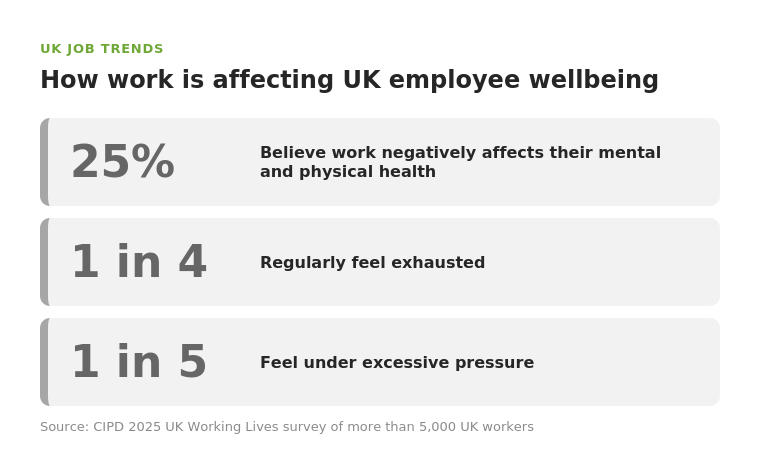
The CIPD’s 2025 survey of more than 5,000 UK workers found that around a quarter believed work had a negative effect on their mental and physical health. Nearly one in four regularly felt exhausted, while approximately one in five felt under excessive pressure. High workloads, poor working relationships and unsupportive management were all associated with worse mental health outcomes. Employers should therefore examine how work is designed and managed, rather than relying entirely on employees to build greater resilience.
Provide mental health education
Apart from helping employees to better understand co-workers who are experiencing psychological distress, mental health education can help them to take better care of their own mental health. For example, training in stress-reduction techniques and coping strategies can equip employees with the skills they need to dissipate tension and avert burnout.
However, education should be backed by employers who “walk the talk.” If your organization acknowledges the role of working conditions in mental health, your attempts to create a workplace environment that fosters mental health and work-life balance demonstrate your commitment to employee wellness.
Mental health education should also explain how employees can request support, what confidentiality they can expect and how to raise concerns about discrimination. It should be accompanied by action on workloads, management practices and workplace culture. Otherwise, awareness training may be seen as placing responsibility for workplace mental health on employees themselves.
Train managers and supervisors
Often, people who are approaching breaking point are unaware that their mental health is at risk. For example, a person who is experiencing stress-related mood swings may not realize that it’s a symptom of a mental health challenge. When managers and supervisors are aware of the symptoms a person in need of support may exhibit, they can open the conversation, providing an environment in which employees feel more comfortable about discussing their mental health. Recent CIPD research supports the value of this training. In organisations providing mental health training for managers, 63% reported that managers were confident in identifying early warning signs, compared with 45% in organisations without training.
Managers should not be expected to diagnose mental health conditions. Their role is to ask open and non-judgemental questions, listen, protect confidentiality, consider reasonable adjustments and direct employees towards appropriate professional help. Regular refresher training can also help managers recognise unconscious bias and avoid treating mental health-related behaviour as a performance or disciplinary issue without first exploring whether support is needed.
The business case for supporting mental health at work
Mental health, job satisfaction, and performance are closely linked. Happy employees perform better and are more likely to remain with the companies they serve. Losing employees is costly. Apart from incurring recruitment, onboarding, and training costs when appointing replacements, institutional knowledge suffers a blow while team dynamics must readjust to the loss of old team members and the introduction of new ones.
The CIPD’s 2025 research reinforces this business case. Employees who felt that work negatively affected their mental health were more than twice as likely to be considering leaving their job, at 34% compared with 14%, and far less likely to recommend their employer.
By creating a workplace culture that promotes mental health and recognizes the challenges workers face, organizations do much more than simply protect themselves against mental health discrimination claims. Instead, they create an environment in which employees feel supported and accepted. This, in turn, promotes loyalty as employers show their willingness to stand by their employees through both good and bad times.
Mental health support can also strengthen productivity by helping employees address difficulties before they escalate into prolonged absence or disengagement. Early, accessible support enables people to stay connected to work, maintain performance, and contribute more consistently over time.
Your mental health policies will help you to retain high-performing employees and attract fresh talent. According to a survey, one in three workers prefer companies that offer mental health support. Experts agree that it is companies’ willingness to assist employees that tips the balance for job seekers. They may be fine right now, but if life and work begin to take their toll on mental health, they know their employers will support them and aid them in achieving recovery.