







Gen Z is entering the US workforce during a difficult period for early-career hiring. Employers are receiving more applications for many roles, yet younger workers are securing a smaller share of new opportunities. At the same time, Gen Z candidates are making careful decisions about the employers they join and what would encourage them to stay.
For recruitment teams, the challenge is to attract capable candidates while understanding what younger applicants expect from the hiring process. Broadbean supports this work by helping employers distribute vacancies across relevant channels, monitor performance and refine their approach using recruitment advertising data.
Who Gen Z Workers Are and Why They Matter to US Employers
Gen Z includes young adults beginning their careers as well as workers with several years of professional experience. They are joining the workforce as many employers consider how to replace knowledge and experience that may be lost as older employees retire.
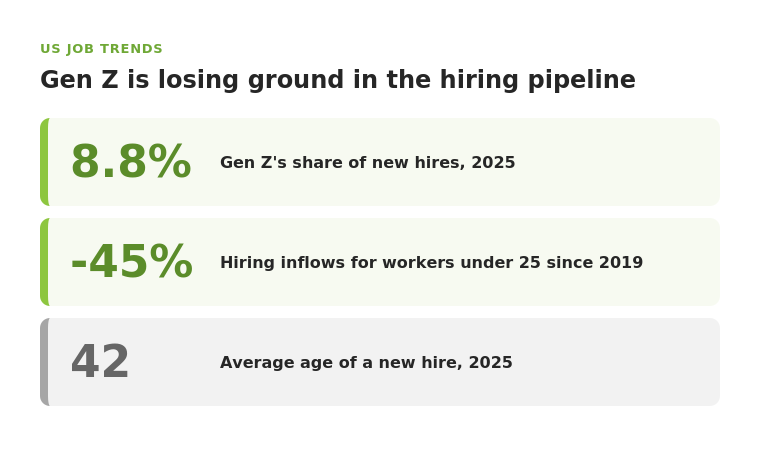
However, the pipeline for younger candidates has narrowed. According to Fortune, Gen Z’s share of new hires fell from 14.9% in 2022 to 8.8% in 2025, while hiring inflows for workers under 25 declined by 45% since 2019. The average age of a new hire reached 42 in 2025.
These figures suggest that employers need to look carefully at whether their recruitment activity is reaching younger candidates and giving them a realistic route into the organization. A shrinking early-career pipeline can create longer-term skills gaps, particularly when entry-level roles provide the foundation for future specialist and leadership positions.
Gen Z Hiring Trends in the US in 2026
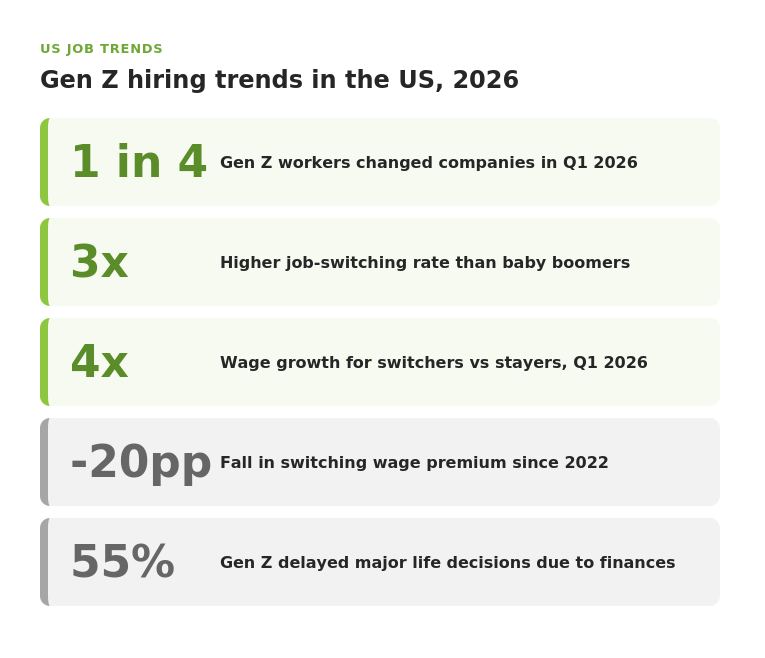
Several Gen Z hiring trends reflect the pressures of the wider labor market. Fortune also reports that more than one in four Gen Z workers changed companies during the first quarter of 2026, more than twice the rate recorded among millennials and more than three times the rate among baby boomers.
Job switching can still increase earnings for younger workers, although the financial incentive has weakened. Gen Z employees who changed jobs saw more than four times the wage growth of those who stayed with their employer during the first quarter of 2026, but the gains associated with switching have fallen by approximately 20 percentage points since 2022.
Financial pressure is also influencing career decisions. The 2026 Deloitte Global Gen Z and Millennial Survey found that 55% of Gen Z respondents had delayed major life decisions, such as starting a family, pursuing further education or setting up a business, because of their financial situation.
Employers should therefore avoid making broad assumptions about loyalty. Younger candidates may be open to staying with an organization when the role offers credible opportunities to develop and the working conditions remain sustainable.
Gen Z Hiring Challenges Employers Need to Address
One of the clearest Gen Z hiring challenges is the gap between the development opportunities candidates want and the investment they feel employers are making.
The 2025 EY US Generation Survey found that 99% of Gen Z respondents had worked on developing their professional skills during the previous year. Gen Z was also the generation most likely to say that its employer was investing in professional growth and development, although the figure remained at 41%. Across all generations, only 36% of respondents felt that their employer was making this investment.
Flexibility can also be misunderstood. In the same EY survey, 42% of US professionals said that some form of hybrid working would be among their priorities when accepting a role. For 20% of Gen Z respondents, flexibility meant being able to take personal days or time off without experiencing negative consequences. This is a useful reminder that flexible working policies need to be explained clearly rather than presented as a vague promise.
What Gen Z Hires Want from an Employer
The latest Gen Z recruiting trends point towards a more considered approach to career decisions. Pay remains important, particularly in a period of financial uncertainty, but it is one part of a broader calculation.
The 2025 EY US Generation Survey found that 48% of Gen Z respondents wanted to work for a company that reflected their values, up from 45% in 2022. Gen Z was also less likely than older generations to rank pay as a leading factor when accepting a new role: 57% selected pay, compared with an average of 74% among millennials, Gen X and baby boomers. Almost one in four Gen Z respondents said that learning and upskilling opportunities could influence their choice of role.
Employers can respond by making job advertisements more specific. A vacancy should explain how the role contributes to the organization, what development may be available and how flexibility works in day-to-day practice. General claims about culture carry less weight when candidates cannot see how they apply to the position being advertised.
Practical Steps to Strengthen a Gen Z Hiring Strategy
Step 1 – Review advert visibility
A more effective Gen Z hiring strategy starts with visibility. Employers should review where early-career roles are advertised, which sources produce relevant applications and whether the wording of each advert reflects the expectations of the candidates they hope to reach.
Step 2 – Distribute and compare by source
Broadbean helps recruitment teams distribute vacancies across multiple job boards, search engines and social media channels from one system. Its reporting tools allow recruiters to compare performance by source and identify where advertising spend is producing suitable candidates. This can help employers refine campaigns over time rather than relying on the same channels for every vacancy.
Step 3 – Streamline the post-application experience
Recruiters should also review what happens after an application is submitted. Clear communication, a manageable interview process and timely updates can influence how candidates view the employer. Where a role includes learning opportunities, hybrid working or a defined route for progression, recruiters should explain these points clearly throughout the process.
Conclusion
Gen Z hiring in 2026 is taking place within a more competitive and cautious labor market. Younger candidates are developing their skills, weighing up financial pressures and looking closely at how employers treat their people.
Recruitment teams that communicate clearly, advertise through the right channels and assess performance carefully will be better placed to attract suitable candidates. To explore how Broadbean can support your recruitment advertising strategy, contact the Broadbean team.