









This website uses cookies so that we can provide you with the best user experience possible. Cookie information is stored in your browser and performs functions such as recognising you when you return to our website and helping our team to understand which sections of the website you find most interesting and useful.
The biggest job trends in the US in 2026 include continued health care growth, rising demand for AI and specialist skills, and a low-hire, low-fire market shaped by cautious employer spending. Hiring is continuing, although growth remains uneven across industries and many organizations are becoming more selective about adding new roles.
Artificial intelligence is influencing both the positions being created and the capabilities employers need. Demand is rising for AI engineers, consultants, strategists and data specialists, while health care remains one of the strongest sources of employment growth. New-home sales, mental health services and other specialist fields are also creating opportunities.
For employers, understanding these trends can support workforce planning, salary benchmarking and recruitment advertising in a more selective market.
What’s Driving the US Job Market in 2026?
The US labor market is still adding jobs, although monthly results have varied considerably. According to the latest Bureau of Labor Statistics employment data, nonfarm payroll employment increased by 57,000 in June 2026, following revised gains of 148,000 in April and 129,000 in May. The unemployment rate stood at 4.2% in June.
The three-month average reached approximately 111,000 jobs by June, although the 12-month average remained considerably lower at 36,000 per month. These figures describe a market that is expanding at a slower and less consistent rate than employers experienced during the post-pandemic recovery.
The phrase “low hire, low fire” has increasingly been used to describe the current environment. Many organizations appear reluctant to expand their workforces quickly while economic conditions remain uncertain. Layoffs have also remained relatively contained across much of the private sector, allowing unemployment to stay within a comparatively narrow range.
Labor supply is influencing these figures. The labor-force participation rate fell to 61.5% in June, compared with 62.3% a year earlier. Retirements, lower immigration and demographic changes can restrict the number of people entering or returning to the workforce, which may help keep unemployment low even when job creation slows.
Government employment has followed a different direction. Federal payrolls have contracted following reductions in departments and agencies, creating a structural change in a sector that previously provided a relatively stable source of employment. Some displaced workers may move into consulting, technology, health care or other professional fields, although the transition will depend on location and transferable skills.
Wage growth has also moderated. Average hourly earnings increased by 3.5% over the year to June, compared with stronger growth during earlier stages of the labor-market recovery. Employers are therefore balancing cost control with the need to offer competitive pay in specialist areas.
Key statistics
- Nonfarm payroll employment increased by 57,000 in June 2026.
- The unemployment rate was 4.2% in June.
- Revised employment gains reached 148,000 in April and 129,000 in May.
- The three-month average reached approximately 111,000 jobs.
- The labor-force participation rate fell to 61.5%.
- Average hourly earnings increased by 3.5% year on year.
The Fastest-Growing Job Titles in the US Right Now
Artificial intelligence occupies several of the leading positions in LinkedIn’s 2026 Jobs on the Rise ranking. AI engineers rank first, with the highest concentration of opportunities in San Francisco, New York City and Dallas.
Demand extends across machine learning, model development, retrieval systems and software implementation. Broadbean’s analysis of AI recruitment trends and salaries found that employers advertised 19,297 AI and machine-learning engineer vacancies during the first quarter of 2026. This represented a 94.5% increase from the same quarter in 2025.
AI consultants and strategists rank second in LinkedIn’s list. These professionals help organizations identify appropriate uses for AI, plan implementation and connect technical investment with commercial goals. The median level of prior experience is 8.2 years, suggesting that employers often seek candidates who combine AI knowledge with established business or product experience. Around 30.3% of the roles identified by LinkedIn offered remote work, with a further 32.8% available on a hybrid basis.
New-home sales specialists rank third, with demand concentrated in Houston, Dallas and Orlando. The rise of this position indicates renewed activity in parts of the residential property market, particularly in regions where new construction and population growth continue to support development.
Data annotators rank fourth. These employees prepare, label and review information used to train machine-learning models. The role can draw candidates from content, editorial, analytical and research backgrounds, making it one of the more accessible entry points into the AI employment market. LinkedIn found that 27.5% of data-annotation roles offered remote working.
The growth in founder titles provides another view of the labor market. Founder roles increased by 69% year on year on LinkedIn, reflecting interest in entrepreneurship, independent work and smaller technology-led businesses. Professionals facing slower corporate recruitment may also be creating their own employment opportunities or presenting consultancy work under a founder title.
Psychiatric nurse practitioners appear further down the ranking but remain significant. Approximately 57.7% of the positions analyzed offered remote availability, reflecting the continued growth of telehealth alongside demand for mental health care.
Employers recruiting across these fields may need a wider advertising mix to reach candidates with different levels of experience. Access to a broad selection of job boards can help recruitment teams compare general, specialist and regional channels.
Key statistics
- AI engineer is LinkedIn’s fastest-growing US job title for 2026.
- AI and machine-learning engineer vacancies reached 19,297 in Q1 2026.
- AI and machine-learning engineer vacancies increased by 94.5% year on year.
- AI consultants and strategists have a median 8.2 years of prior experience.
- Remote availability reached 30.3% for AI consultants and strategists.
- Founder titles increased by 69% year on year.
- Remote availability reached 57.7% for psychiatric nurse practitioners.
Which Industries Are Hiring the Most in the US in 2026?
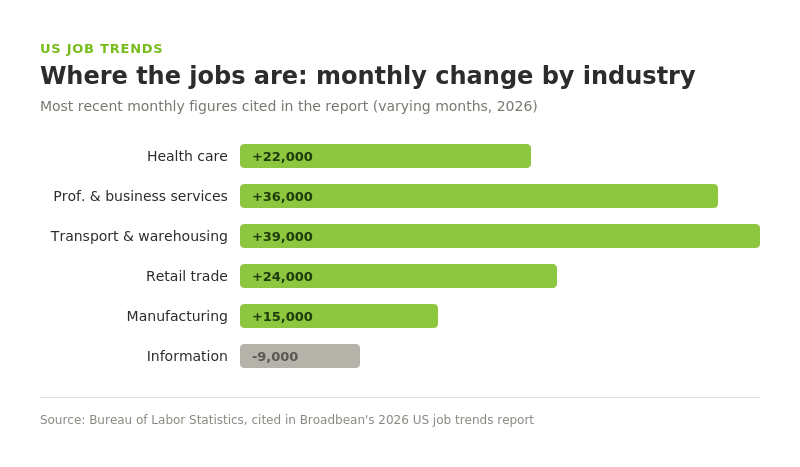
Health care remains one of the strongest sources of employment growth. The sector added approximately 22,000 jobs in June and averaged 38,000 new jobs per month over the previous year. Demand spans clinical, administrative, support and technology roles, with psychiatric nurse practitioners and health care reimbursement specialists appearing among LinkedIn’s fastest-growing positions.
Professional and business services added 36,000 jobs in June, supported by hiring in consulting, accounting, engineering, technical services and corporate functions. Growth in AI consulting, strategic advisory work and independent consulting is also contributing to demand.
Transportation and warehousing added a revised 39,000 jobs in April, led by courier, messenger, distribution and fulfillment services. Growth slowed in the following months, but e-commerce and supply-chain activity continue to support recruitment.
Retail trade added approximately 24,000 jobs in April before growth weakened in May and employment declined in June. Warehouse clubs, general merchandise retailers and large chains continue to hire, although demand remains sensitive to consumer confidence and seasonal activity.
The information sector presents a different picture. Employment fell by 9,000 in June after declines in April and May, leaving the sector well below its late-2022 peak. This shows that demand for specialist AI and technology skills can rise even as total employment falls across media, publishing, telecommunications and other parts of the sector.
Manufacturing added 15,000 jobs in March, its strongest monthly gain in more than two years, before recording smaller changes in the following months. Employers in advanced manufacturing, automation and industrial technology may still face shortages in specialist technical roles despite modest overall growth.
Technology and the Internet was the most common industry across many of LinkedIn’s fastest-growing roles. IT services, consulting and technology also appeared frequently, showing how digital expertise is spreading across the wider economy.
Key statistics
- Health care added approximately 22,000 jobs in June 2026.
- Health care averaged 38,000 additional jobs per month over the preceding year.
- Professional and business services added 36,000 jobs in June.
- Transportation and warehousing added approximately 39,000 jobs in April.
- Retail trade added approximately 24,000 jobs in April.
- Information employment declined by 9,000 in June.
- Manufacturing added 15,000 jobs in March.
Salary Trends for the Most In-Demand US Jobs in 2026
Salary growth across the wider labor market has slowed, while specialist AI positions continue to attract substantial pay premiums.
Broadbean’s Q1 2026 analysis found that the median salary for AI-related jobs reached $162,240. This was 3.2% higher than the Q1 2025 median of $156,998 and 3.8% above the Q1 2024 figure. Quarter on quarter, however, the median declined by 0.6%, from $163,280 in Q4 2025.
The figures suggest that AI salaries remain elevated while increases are becoming more measured. Vacancy growth has been much faster: the number of advertised AI roles increased by 36% year on year and 48.9% over two years.
AI skills also command a premium over the wider technology market. The median salary for non-AI IT roles was $132,506, which placed the AI median $29,734 higher. AI software developers earned a median of $169,052, compared with $145,600 for software developers outside the AI category.
Across all private nonfarm employees, average hourly earnings reached $37.64 in June 2026, representing annual growth of 3.5%. Sector differences remain considerable. Information and professional services tend to pay well above the national private-sector average, while leisure and hospitality wages remain substantially lower.
Employers should therefore avoid relying solely on broad market averages when setting salaries. Location, seniority, technical specialization and the availability of remote work can all affect candidate expectations. Accurate benchmarking becomes especially important when vacancies require a combination of technical and commercial knowledge.
Recruitment teams also need visibility over which channels produce appropriately qualified candidates at the required salary level. A centralized applicant-tracking system such as Aplitrak can help teams manage applications and compare recruitment activity across vacancies.
Key statistics
- The median AI salary reached $162,240 in Q1 2026.
- Median AI salaries increased by 3.2% year on year.
- AI vacancies increased by 36% over the same period.
- AI roles paid 22.4% more than non-AI IT roles at the median.
- AI software developers earned a median salary of $169,052.
- Average hourly earnings across private payrolls reached $37.64 in June.
- Overall annual earnings growth stood at 3.5%.
The Most In-Demand Skills US Employers Are Hiring for in 2026
The fastest-growing AI roles require increasingly specialized technical knowledge. LinkedIn identifies LangChain, retrieval-augmented generation and PyTorch among the leading skills for AI engineers, while large language models, MLOps and computer vision feature prominently in AI consulting and research roles.
Demand also extends beyond technical development. Strategic advisors are expected to bring experience in executive advisory, go-to-market strategy and strategic partnerships, helping organizations assess where AI can support commercial priorities and guide investment.
Broadbean’s recruitment data shows demand across the AI talent pipeline, from data annotators and software developers to architects, researchers and product managers. Experience requirements vary considerably: AI engineers have a median of 3.7 years of prior experience, compared with 8.2 years for AI consultants and strategists and 3.5 years for data annotators.
Flexible working remains common across many growing occupations. AI engineer roles were 26.2% remote and 27.1% hybrid, while AI consultant positions were 30.3% remote and 32.8% hybrid. Roles linked to laboratories, production sites, hospitals, construction projects and data centers may still require an on-site presence, while remote and hybrid arrangements can help employers reach candidates beyond their immediate location.
Key statistics
- LangChain, retrieval-augmented generation and PyTorch are leading AI engineering skills.
- LLMs, MLOps and computer vision are prominent in AI consulting.
- Executive advisory and go-to-market strategy are central to strategic advisory roles.
- AI engineers have a median 3.7 years of prior experience.
- AI consultants and strategists have a median 8.2 years of prior experience.
- AI engineer roles were 26.2% remote and 27.1% hybrid.
- AI consultant roles were 30.3% remote and 32.8% hybrid.
What Job Trends Should Employers and Candidates Watch in the Second Half of 2026?
The second half of 2026 is likely to remain uneven. June job growth slowed to 57,000, despite stronger revised figures for April and May, while lower labor-supply growth may help keep unemployment relatively stable. Employers could therefore face modest national growth alongside persistent shortages in specific occupations and locations.
Underemployment remains an important indicator. The number of people working part time for economic reasons reached 4.9 million in April before falling to approximately 4.7 million in June. A renewed increase could point to reduced hours or difficulty securing full-time work.
Energy costs and geopolitical uncertainty may also affect hiring through higher transport, production and operating expenses. These pressures may first appear through delayed vacancies, unfilled roles or scaled-back expansion plans.
AI-related positions are expected to remain prominent as the employment ecosystem becomes more established. Data annotators prepare training information, engineers develop systems, researchers improve models, consultants advise on adoption and product managers connect development with business requirements.
As these roles become more specialized, employers may need to review their recruitment advertising. Clear job titles, skills, salary information and working arrangements can help candidates assess opportunities more easily. Broadbean helps organizations distribute vacancies, monitor channel performance and manage recruitment advertising from one platform. Employers can request a demonstration to review how this could support their hiring activity.
Key statistics
- Nonfarm payroll employment increased by 57,000 in June.
- The three-month job-growth average reached approximately 111,000.
- The labor-force participation rate fell to 61.5%.
- Around 4.7 million people were working part time for economic reasons in June.
- AI-related vacancies increased by 36% year on year in Q1 2026.
- AI-related vacancies reached 55,374 during the first quarter.