








This website uses cookies so that we can provide you with the best user experience possible. Cookie information is stored in your browser and performs functions such as recognising you when you return to our website and helping our team to understand which sections of the website you find most interesting and useful.
Recruiters and hiring managers generally aim to assess applicants fairly, but assumptions and personal preferences can still influence decisions. Recruitment bias can enter the process through job descriptions, advertising, résumé screening, interviews and final selection. Recognizing where it occurs can help employers introduce clearer criteria and improve consistency.
What Is Hiring Bias?
Hiring bias occurs when a candidate’s personal characteristics, background or circumstances unfairly influence their progress through the recruitment process. It can affect who sees a vacancy, who decides to apply, which applications are shortlisted and how candidates are evaluated during interviews.
Bias in recruitment may relate to age, race, ethnicity, religion, sex, gender identity, sexual orientation, disability or family circumstances. Recruiters may also be influenced by a candidate’s name, accent, address, education, previous employers or career path, even when these details have limited relevance to their ability to perform the role.
Some forms of bias are conscious, while others arise through automatic associations that the decision-maker may not recognize.
What Are the Different Types of Hiring Bias?
Conscious Bias
Conscious bias occurs when someone knowingly allows a personal preference or assumption to influence a recruitment decision. This could include favoring applicants from particular universities, preferring candidates from a familiar professional background or discounting an older applicant because of assumptions about their technical ability.
Unconscious Bias
Unconscious bias involves automatic judgments that affect how information is interpreted. A hiring manager may assess the same behavior differently depending on a candidate’s gender, age, race, disability, religion or perceived social background.
These associations can influence how résumés are read, how interview answers are interpreted and whether a candidate is regarded as a good fit. Clear assessment criteria can help reduce their influence.
Affinity Bias
Affinity bias leads people to respond more positively to candidates with whom they share interests, experiences or characteristics. A common hometown, university, former employer or hobby may create easy rapport without providing evidence of how well the candidate would perform.
Name and Background Bias
A candidate’s name, address, education or employment history can suggest their race, ethnicity, gender or socioeconomic background. These signals may influence whether an application is viewed positively before the person’s experience has been assessed in full.
A well-known US field experiment found that résumés assigned White-sounding names received substantially more callbacks than equivalent résumés assigned African American-sounding names.
Halo Effect
The halo effect occurs when one favorable characteristic influences the wider assessment of a candidate. An impressive qualification, prestigious former employer, confident manner or strong first answer may lead an interviewer to assume strengths that have not been demonstrated.
The reverse can also occur, with one perceived weakness overshadowing otherwise relevant evidence.
What Is the Impact of Hiring Bias?
Hiring bias can affect appointment quality, workforce representation and candidate perceptions, while potentially increasing legal risk.
A US survey of 400 hiring managers and 400 job seekers found that 15% of hiring managers acknowledged that age had influenced a hiring decision during the previous two years. Ethnicity was cited by 11%, while 9% acknowledged being influenced by disability. Among the job seekers surveyed, 52% said they frequently experienced discrimination during recruitment.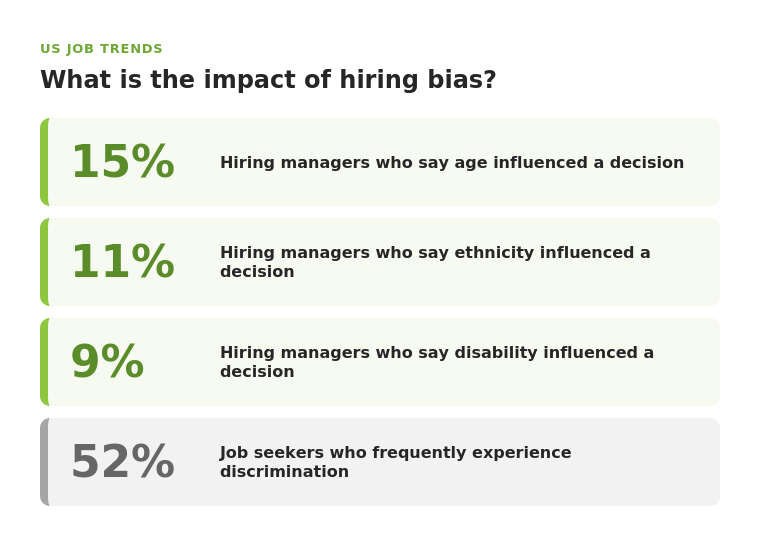
Overlooking Qualified Candidates
When irrelevant characteristics influence screening or interviews, employers may reject candidates who have the skills and experience required for the role. They may also appoint someone who created a favorable personal impression without providing the strongest evidence of ability.
Missing the Advantages of a Diverse Workforce
A narrow recruitment process can result in teams whose members have similar backgrounds and perspectives. This may limit the range of experiences available when employees approach customers, workplace challenges or new opportunities.
Reducing bias can help employers widen their talent pools and create a workforce that reflects a broader range of communities, professional routes and viewpoints.
Damaging the Candidate Experience
Candidates may develop a negative view of an employer when they encounter exclusionary language, inconsistent interview questions or selection criteria that appear unrelated to the role.
Their experience can influence whether they apply again, accept an offer or recommend the organization to others.
Increasing Legal and Compliance Risk
US federal law prohibits employment discrimination based on race, color, religion, sex, national origin, age, disability and genetic information. These protections apply to job advertisements, recruitment methods, applications, assessments and hiring decisions.
The US Equal Employment Opportunity Commission also warns that apparently neutral practices may be unlawful when they disproportionately disadvantage protected applicants without being job-related and necessary.
What Are the Benefits of Reducing Hiring Bias?
Access to a Wider Talent Pool
Inclusive advertising and proportionate requirements can encourage applications from candidates outside an employer’s established recruitment networks.
More Consistent Hiring Decisions
Structured screening, interviews and scoring allow candidates to be assessed against the same expectations.
Better Candidate Experiences
Clear criteria and consistent assessments help applicants understand how decisions are made.
Greater Workforce Representation
Removing unnecessary barriers can improve representation across applicant pools, shortlists and appointments.
Clearer Recruitment Data
A data-driven hiring process can reveal disparities in application, progression and appointment rates.
6 Strategies to Help Reduce Hiring Bias in the Workplace
1. Remove Biased Language From Job Descriptions
Biased language in job descriptions can discourage underrepresented candidates before they have considered the full role. Research into gender-coded wording found that masculine language in job advertisements can make roles less appealing to women by affecting their sense of belonging.
Review job descriptions and advertisements for:
- Masculine-coded terms such as “dominant,” “aggressive” or “competitive”
- Age-related phrases such as “digital native” or “young and dynamic”
- Cultural signals such as “work hard, play hard”
- Requirements that are preferred rather than essential
- Language that may discourage disabled candidates or caregivers
- References to personality traits that are difficult to assess consistently
Removing unnecessary criteria can help more candidates recognize that their skills are relevant.
2. Advertise Widely and Try New Channels
A well-written, inclusive job advertisement may still reach a limited audience when it appears on the same channels for every vacancy.
Employers can broaden their reach through general and specialist job boards, professional networks and platforms serving candidates from underrepresented groups. These may include job boards focused on women, Black professionals, LGBTQ+ candidates or disabled job seekers.
Programmatic recruitment advertising can also distribute vacancies according to defined audiences, budgets and performance data, helping recruitment teams move beyond familiar sources.
3. Follow Structured Interviews
Structured interviews use predetermined, job-related questions asked in the same order, with answers assessed against consistent scoring criteria.
The questions should reflect the skills and responsibilities of the role, while the scoring rubric should explain what weak, satisfactory and strong evidence looks like. This allows interviewers to compare candidates using the same information.
Practical steps include:
- Agreeing the essential competencies before interviews begin
- Asking every candidate the same core questions
- Using the same follow-up prompts where clarification is required
- Recording evidence from each answer
- Scoring candidates independently before the panel discusses them
4. Use Blind or Anonymous Applications
Blind screening removes identifying information from applications before they are reviewed. Depending on the recruitment process, this may include names, photographs, addresses, universities and graduation dates.
The aim is to help screeners focus on skills and experience without reacting to cues that may suggest a candidate’s gender, ethnicity, age or socioeconomic background.
It should form part of a wider approach that includes structured criteria and outcome monitoring. Employers using automated screening tools should also review how those systems were developed and tested, as technology trained on unrepresentative historical data may reproduce existing patterns.
5. Use Diverse Hiring Panels
A diverse hiring panel includes people with different backgrounds, genders, professional experiences and perspectives.
A panel made up of very similar decision-makers may be more susceptible to shared assumptions or affinity bias. Broader representation can introduce additional viewpoints and encourage members to explain how their assessments relate to the agreed criteria.
Panelists should score candidates independently before discussing their conclusions. This reduces the likelihood that the first or most senior person to speak will influence the rest of the group.
6. Introduce Skills-Based and Data-Driven Screening
Skills-based screening places greater emphasis on demonstrated ability and less on proxies such as educational prestige, previous employers or conventional career paths.
Assessment methods may include:
- Work samples based on realistic job tasks
- Structured technical or practical exercises
- Standardized application scoring
- Job-related case studies
- Consistent interview scorecards
Any test should measure skills that are genuinely required and provide candidates with clear, accessible instructions. Employers should also consider whether reasonable adjustments are needed so that disabled applicants can participate fairly.
Technology such as Aplitrak can support consistent application management and recruitment reporting. Hiring teams can use the resulting data to examine which candidates apply, progress and receive offers, while checking whether particular stages produce unexplained disparities.
Reducing hiring bias requires attention throughout the recruitment process, supported by regular reviews, candidate feedback and recruitment data.
Broadbean helps recruitment teams distribute vacancies across relevant channels, manage applications and monitor campaign performance from one platform. Request a demo to explore how Broadbean can support a more consistent recruitment process.